Cart Before the Store: How Incheon's Night Markets Are Teaching the World a New Lesson in Small Business
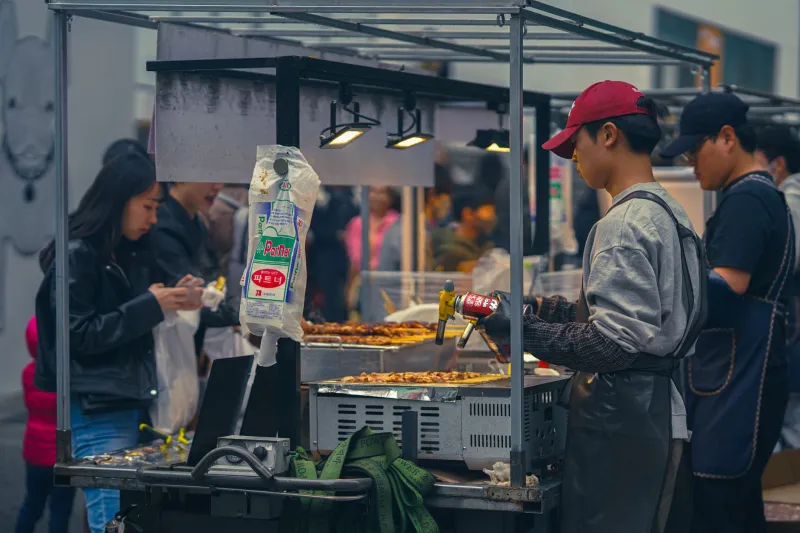
There's a moment, usually somewhere around 9 p.m. on a Friday, when Bupyeong's underground arcade market stops feeling like a shopping destination and starts feeling like something else entirely. The fluorescent lights catch the steam rising off a dozen different food carts. A vendor in her mid-twenties is live-streaming her tteokbokki prep to a few hundred followers. Two stalls down, a guy who looks like he should be in a band — and probably is — is selling hand-screen-printed hoodies next to a cart of vintage sneakers he's been quietly flipping since college.
This is Incheon's night market economy. And if you haven't been paying attention, you're about a year behind.
More Than a Place to Eat
Americans tend to think of night markets as tourist experiences — places to grab interesting snacks, take some photos, and move on. That framing misses almost everything important about what's actually happening in spots like Bupyeong Kkangtong Market or the stretch of vendor stalls that bleeds out from Incheon Chinatown toward Jayu Park after dark.
These aren't just food courts under the open sky. They're functioning entrepreneurial ecosystems with their own internal logic, their own informal networks, and increasingly, their own career pipelines. The vendors here aren't waiting to graduate into brick-and-mortar retail. For a growing number of them, the cart is the business model — refined, intentional, and surprisingly sophisticated.
Kim Soyeon, 27, has been running a dessert cart in Bupyeong for two years. She sells a rotating menu of fusion bingsu — think matcha with mango sorbet, or a brown butter and red bean combination she developed by watching American pastry content on YouTube. She keeps a waitlist on KakaoTalk, posts her weekly menu on Instagram Stories every Sunday night, and does somewhere between 80 and 120 transactions on a good weekend evening. She has no plans to open a café.
"A café means rent, staff, permits, equipment loans," she said, speaking through a translator. "Here I control everything. My overhead is low. My customers come to me. Why would I make it more complicated?"
The Hybrid Model Nobody's Officially Named Yet
What's emerging in Incheon's markets is something American business culture is still fumbling toward: a hybrid between pop-up retail, direct-to-consumer sales, and community-based brand building — all operating at street level, without the venture capital or the TED talk.
Vendors here routinely test products before committing to them, the same way a tech startup would run a beta. A new snack item might appear for two weekends. If it sells out, it becomes a staple. If customers are lukewarm, it disappears without a press release or a post-mortem. The market provides real-time feedback that no focus group can replicate.
There's also a collaboration culture that would feel at home in Brooklyn or East Austin, except it's been happening here longer and with less self-consciousness about it. Food vendors swap ingredients. A clothing seller and a jewelry maker share a combined setup to split the stall fee and cross-promote to each other's customers. Someone who makes candles will leave a stack of cards at a nearby skincare cart. It's informal, it's efficient, and it works.
Incheon's markets also benefit from something Seoul's more polished commercial districts simply don't offer: low barriers to entry. Getting a stall in Bupyeong costs a fraction of what even a pop-up space in Hongdae would run. That affordability lets younger vendors experiment without betting their savings on a single concept — which is exactly the kind of environment where creative business ideas actually get tested.
Why Incheon and Not Seoul?
It's worth asking why this particular energy has taken root in Incheon rather than in the capital. Part of the answer is real estate. Seoul's commercial districts — even the ones that used to be scrappy — have been priced and polished into a kind of brand-safe uniformity. The organic weirdness that once made places like Hongdae or Insadong interesting has been largely smoothed out by the same market forces that turned parts of New York's Lower East Side into a luxury retail corridor.
Incheon still has friction. It still has rough edges and underutilized spaces and landlords who haven't figured out that they're sitting on something valuable. And that friction, paradoxically, is exactly what makes it fertile ground for the kind of grassroots commerce that tends to generate genuinely new ideas.
There's also a community dimension that's hard to overstate. The vendors in Incheon's night markets aren't anonymous. Regulars know their names. They follow them on social media between visits. When a vendor raises prices or changes their menu, they hear about it directly from customers — not through a comment section, but face to face, at the cart, while the transaction is happening. That kind of direct relationship between maker and buyer is something American small business culture talks about constantly and achieves only occasionally.
What American Small Business Owners Can Actually Take Away
If you run a small business in the US — or you're thinking about starting one — the Incheon night market model has a few things worth sitting with.
First: low overhead isn't a consolation prize. It's a strategic advantage. The vendors thriving in Bupyeong aren't dreaming of the day they can afford more space. They've built models specifically calibrated to what they can control. That discipline keeps them nimble in ways that fixed-cost businesses simply can't be.
Second: community is the algorithm. These vendors don't rely on paid ads or platform recommendations to drive traffic. They build genuine relationships with repeat customers, collaborate with neighboring vendors, and let word of mouth do the work that marketing budgets usually can't. In an era where digital advertising costs keep climbing and organic reach keeps shrinking, that's not a quaint approach — it's a competitive one.
Third: iteration beats perfection. The Incheon market vendor who tests a new recipe for two weekends before deciding whether to keep it is operating on a faster, cheaper feedback loop than most small businesses ever build. The willingness to try something, watch how real customers respond, and adjust without ego is a genuine skill — and it's on full display every night in these markets.
Incheon's night market economy isn't going to be written up in the Harvard Business Review anytime soon. But maybe that's exactly why it's working.